
How to Open an RV Repair Shop
How to open an RV repair shop: RVTI certification, licensing and insurance to check, the building, equipment, parts accounts, software and startup costs.
On this page
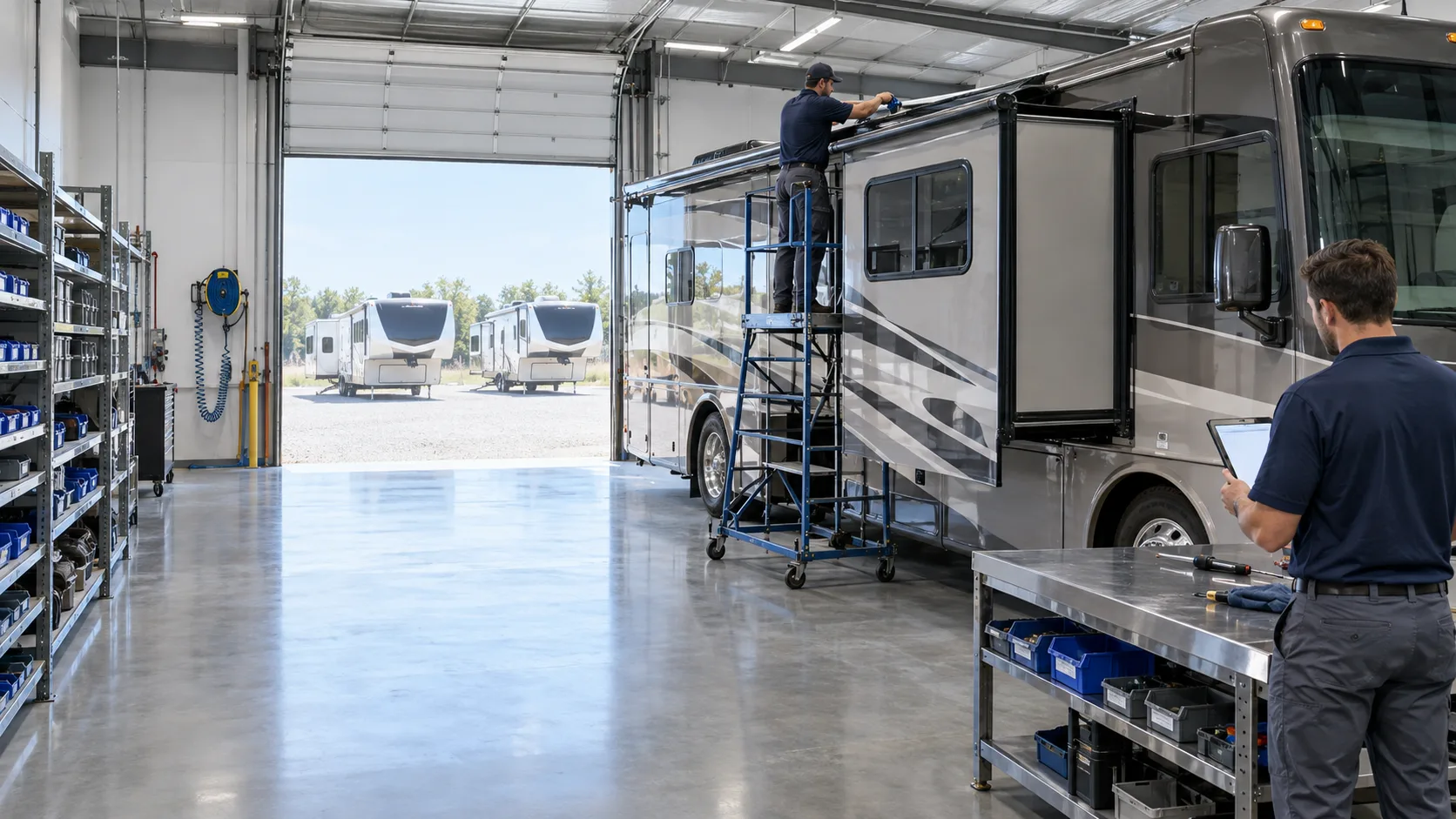
Opening an RV repair shop means taking on everything a mobile tech avoids: a building big enough for a motorhome, bays and equipment, a parts room, staff, and the insurance that comes with holding customers’ rigs overnight. In return you get room to work on several rigs at once, a place customers can drop off, and a business that doesn’t stop when one truck is in the shop.
This guide covers what to work through before you sign a lease: certification, licensing and insurance, the building, equipment, parts accounts, labor rates, the software that runs the front counter, and a way to plan startup costs from your own quotes. If you’d rather start from a truck, our guide to starting a mobile RV repair business covers that path. This is practical guidance, not legal, tax or insurance advice; the rules that apply depend on your state, county and city.
Certification: what the RVTI levels meanLink to the section “Certification: what the RVTI levels mean”
RV work crosses several trades: 12-volt and 120-volt electrical, LP-gas appliances, plumbing, roofs, slide-outs and, on motorhomes, a chassis. The RV Technical Institute (RVTI) offers the industry’s certification path for technicians. According to RVIA’s description of the path:
| Level | What it shows | How it’s kept current |
|---|---|---|
| Level 1: Pre-Delivery Inspector | Can check that an RV’s components work before delivery. Written and practical exams. | Good for life, with a yearly information and employment check-in. |
| Level 2: Basic diagnostics and repair | Knowledge of all RV systems, plus basic diagnostics, troubleshooting and repair. Level 1 and 2 written and practical exams. | Five years, with 24 hours of continuing education. |
| Level 3: Specialist | Approved vendor training in a specialty: electrical, chassis, electronics, appliance or slide-out. | Five years, with 24 hours of continuing education, 8 of them in the specialty. |
| Level 4: Master Technician | All five specialties, with 120 total training hours within five years. | Five years, with 24 hours of continuing education. |
For a new shop, certification does two jobs. It gives customers a reason to trust a name they haven’t heard of, and it gives you a training plan for the techs you hire. One way to use it is to set a target level for each role, such as Level 2 for anyone doing diagnosis, and add specialties around the work the shop sells most. Certification is not the same as a state or local license, which is a separate question.
Licensing, zoning and insurance to checkLink to the section “Licensing, zoning and insurance to check”
Nothing here is legal or insurance advice. These are the questions to take to your state and local agencies, a licensed insurance agent and, where needed, an attorney or accountant.
Licenses, registrations and zoningLink to the section “Licenses, registrations and zoning”
- Business licensing. The U.S. Small Business Administration says most small businesses need a mix of licenses and permits, that states regulate a broader range of activities than the federal government, and that your Secretary of State’s website is the place to start.
- Zoning. The SBA notes that your location determines the zoning laws you’re subject to and that zoning is usually controlled locally. Check with the planning department that a repair shop with outdoor RV storage is allowed on the property before you sign anything.
- State repair registration. Some states register repair businesses. California’s Bureau of Automotive Repair, for example, says registration as an automotive repair dealer is required to diagnose, service or repair vehicles for compensation, lists some exemptions, and shows a $200 annual renewal fee. Ask your state how its rules apply to motorhomes and to towables.
- Sales tax. If you sell parts, ask your state tax agency about a seller’s permit or sales tax registration.
- LP-gas work. Some states license people who work on LP-gas systems. Ask your state which rules apply to RV propane work in your shop.
Insurance categories to ask aboutLink to the section “Insurance categories to ask about”
- General liability. The SBA describes it as protecting against financial loss from bodily injury, property damage and medical expenses, along with costs such as lawsuit defense.
- Garage liability and garagekeepers. The two are easy to confuse. Writing in Insurance Journal, insurance agent Kevin O’Connor describes garage liability as covering injury and property damage caused by garage operations, with an exclusion for customer vehicles in your care, custody or control. Garagekeepers fills that gap: it covers loss to customers’ vehicles while you have them, in legal liability (you were at fault), direct primary (regardless of fault) or direct excess forms. The insurance glossary IRMI notes that the legal liability form depends on establishing that you were liable.
- Workers’ compensation. The U.S. Department of Labor says workers’ comp provides injured workers with wage replacement, medical treatment and vocational rehabilitation, and that private-sector programs run through each state. The SBA lists it among the coverage businesses with employees are required to carry.
- Commercial property. The SBA describes it as covering loss and damage to company property from events such as fire, wind, hail and vandalism. Ask how your tools, lifts and parts inventory are covered.
The building and baysLink to the section “The building and bays”
An RV shop is sized by its biggest customers. A shop that can’t get a tall motorhome or fifth-wheel through the door has to turn that work away. The Federal Highway Administration notes there is no federal vehicle height limit for commercial vehicles; states set their own, most between 13 feet 6 inches and 14 feet, and the width limit on the national network is 102 inches. Those road limits give you a rough sense of the tallest and widest rigs that will arrive, but measure the units you actually plan to service, add room for roof-mounted air conditioners and antennas, and confirm the real clear opening with your door supplier.
Beyond the doors, walk any property with these questions:
- Is there room to swing a long trailer or motorhome into the bay without blocking the lot?
- Is there clearance overhead inside the bay for roof work, and somewhere safe to work at height?
- Where will waiting rigs park, and is that area secure overnight?
- Is there power where you need it, including 30-amp and 50-amp RV outlets to test shore power?
- Is there a counter and a parts room near the bays, and a restroom customers can use?
Equipment, by categoryLink to the section “Equipment, by category”
Buy for the work you plan to sell first and add as the mix grows. Rather than a shopping list with prices, plan by category:
- Access and lifting: scaffolding or roof access, ladders, jacks and stands rated for the weight you’ll lift, and wheel chocks.
- Electrical diagnosis: multimeters, clamp meters, 12-volt test lights, receptacle testers and a battery tester and charger.
- LP-gas: a manometer and leak-detection solution, used to the appliance manufacturer’s procedure.
- Water and air: an air compressor with regulators for winterizing and blowouts. OSHA allows compressed air for cleaning only when reduced to less than 30 psi, with chip guarding and protective equipment.
- Roof and exterior: cleaners, sealants matched to the roof types you’ll service, and lighting for inspection.
- Hand and power tools: shop sets for the bays, with each tech’s own tools depending on your pay plan.
- Front office: computers or tablets for the counter and bays, a card reader, a label printer and a phone line.
Parts accounts and distributorsLink to the section “Parts accounts and distributors”
A shop that waits a week on every part can’t turn its bays. Open accounts before you open the doors. RV parts reach shops through wholesale aftermarket distributors as well as directly from component and RV manufacturers. As one example of who operates in that wholesale market, RVIA’s 2022 RV Aftermarket awards named NTP-STAG Distributor of the Year, with Arrow Distributing and Northern Wholesale Supply as finalists. Ask each distributor about dealer or installer pricing, delivery days to your area, returns and core charges, and what they need to open an account, such as a resale certificate.
Decide early what you’ll stock. Fast-moving items such as sealants, fuses, fittings and common seals belong on the shelf; slow, expensive parts usually get ordered per job. Track cost and price separately for every part from day one, so the profit on each job is real. RVDesk parts inventory holds cost, price, bin location and a reorder point on each part, and parts used on work orders come off the count.
Set your labor rate from your own costsLink to the section “Set your labor rate from your own costs”
Don’t copy the shop across town. Your rate has to cover your technicians’ wages and payroll burden, divided by the hours you can actually bill, plus your building and overhead per billed hour, plus profit. Our guide on how to set RV repair labor rates walks through that calculation step by step. For a new shop, be conservative about billable hours in the first year, when the schedule is still filling.
The software a shop needs to runLink to the section “The software a shop needs to run”
A building full of rigs needs one place where everyone can see what’s happening. Before opening day, make sure you have a way to handle each of these:
- A job board showing every rig in the shop and where it stands
- Estimates customers approve in writing, ideally line by line from their phone
- Parts on hand, on order and on each job, with cost and price
- Invoices that come from the approved work, not retyped
- Payments by card, cash and check recorded against the invoice
- A time clock that records hours against each job as well as the day
RVDesk is RV repair shop software built around that list. Work orders carry the customer, rig, jobs, parts, labor, photos and payments on one record, and the job board shows where every rig stands. Techs see the authorized jobs on their rigs and start and pause a job clock from a phone or tablet. Card payments run through your shop’s own Stripe account, with a card reader at the counter, text-to-pay links, and cash and check on the same ledger. See how it fits independent RV repair shops, and check current pricing.
A cost-planning worksheetLink to the section “A cost-planning worksheet”
We’re not going to give you a startup number. It depends on whether you lease or buy, what the building needs, how many bays you open with and what you already own. The SBA’s startup cost guidance offers a better method: list one-time costs and monthly costs separately, plan for at least a year of monthly expenses, and get real figures by talking to vendors, mentors and service providers. For an RV shop, the lines to price out are:
| One-time costs | Monthly costs |
|---|---|
| Lease deposit or down payment, and building improvements | Rent or mortgage, property tax and maintenance |
| Doors, electrical work and RV outlets, air lines | Utilities, including power and compressed air |
| Lifting, access and diagnostic equipment | Equipment loan or lease payments |
| Opening parts inventory | Parts restocking and shop supplies |
| Licenses, permits and registrations | Insurance premiums |
| Training and certification for your techs | Wages and payroll burden |
| Signs, website and launch marketing | Software, phones, internet and card processing |
| Legal and accounting setup | Accounting, advertising and continuing education |
Add the one-time column to twelve months of the monthly column, and you have the cash the plan needs before revenue. Then ask how many billed hours a month it takes to cover the monthly column at your labor rate. That number tells you how fast the shop has to fill.
An opening checklistLink to the section “An opening checklist”
- Training plan for each tech, with the RVTI levels or vendor training they’ll pursue
- Business licensing, state repair registration and sales tax confirmed
- Zoning confirmed for repair work and rig storage on the property
- Insurance in place, including garagekeepers, after a conversation with a licensed agent
- Building measured against the tallest and longest rigs you plan to service
- Equipment bought for the work you’ll sell first
- Parts accounts open, with delivery days and return terms known
- Labor rate set from your own costs
- Software for the job board, estimates, parts, invoices, payments and time clock set up
- Budget built from real quotes, with a year of monthly costs covered
Common questionsLink to the section “Common questions”
Do you need a license to open an RV repair shop?
It depends on your state, county and city. You’ll likely need general business licensing, and some states register repair businesses; California, for example, requires automotive repair dealer registration to diagnose, service or repair vehicles for compensation. Check zoning, sales tax and any LP-gas rules too.
What certification do RV technicians need?
The RV Technical Institute offers four levels: Level 1 pre-delivery inspection, Level 2 diagnostics and repair, Level 3 specialties in electrical, chassis, electronics, appliance and slide-out, and Level 4 Master Technician. It’s an industry credential, not a government license.
What insurance does an RV repair shop need?
Ask a licensed agent about general liability, garage liability, garagekeepers coverage for customers’ rigs in your care, commercial property, and workers’ compensation once you have employees. Requirements vary by state.
How much does it cost to open an RV repair shop?
There’s no single number. Build your own estimate from quotes: one-time costs such as building improvements, equipment and opening inventory, plus at least a year of monthly costs such as rent, wages, insurance and software, as the SBA recommends.
Want to see how a new shop could run its board, estimates, parts and payments in one place? Book a demo and we’ll walk through it with your shop in mind.
Sources
- RV Industry Association: RV Technical Institute technician path and curriculum (rvia.org)
- U.S. Small Business Administration: Apply for licenses and permits (sba.gov)
- U.S. Small Business Administration: Get business insurance (sba.gov)
- U.S. Small Business Administration: Calculate your startup costs (sba.gov)
- California Bureau of Automotive Repair: Apply for a license (bar.ca.gov)
- Insurance Journal: Garage Liability or Garagekeepers? That Is the Question (Kevin O’Connor, 2014) (insurancejournal.com)
- IRMI: Garagekeepers coverage (insurance glossary) (irmi.com)
- U.S. Department of Labor: Workers’ compensation (dol.gov)
- Federal Highway Administration: Federal size regulations for commercial motor vehicles (ops.fhwa.dot.gov)
- OSHA: 29 CFR 1910.242, Hand and portable powered tools and equipment, general (osha.gov)
- RV Industry Association: Top performers celebrated during RV Aftermarket Awards in San Antonio (2022) (rvia.org)
We build RVDesk alongside a mobile RV repair business in Redding, California.