
Getting Paid Faster at Your RV Repair Shop
Practical payment policies for RV repair shops: deposits on big jobs, card readers at the counter, text-to-pay links, payment at pickup and less money owed.
On this page
- Write the payment policy down
- Take deposits on big jobs and special-order parts
- Run cards on a reader, not by hand
- Send a text-to-pay link when the customer isn’t there
- Make payment at pickup the default
- Document authorization so the bill holds up
- Keep accounts receivable short
- If you’re thinking about card surcharges
- Common questions
- Sources
Every day between finishing a job and getting paid for it, your shop is financing the customer’s repair. RV work makes that gap easy to widen: special-order parts paid for weeks before the job closes, big tickets, owners who are traveling when the rig is ready, and rigs that sit on the lot after the work is done.
Getting paid faster is mostly policy, not persuasion. This guide covers the practical pieces: a written payment policy, deposits on big jobs, card readers at the counter, text-to-pay links, payment at pickup, documenting authorization so the bill holds up, and keeping what customers owe you short.
Write the payment policy downLink to the section “Write the payment policy down”
A policy that lives in the owner’s head gets applied differently by every advisor and argued about by every customer. Put it in writing, show it before work starts and apply it the same way every time. Most RV shops need a policy that covers:
- When payment is due. For most customers: in full, at pickup.
- Which jobs need a deposit, how much, and when it’s refundable.
- Which payment methods you accept, and whether you accept checks.
- Who, if anyone, gets terms instead of paying at pickup, such as commercial or fleet accounts you’ve approved.
- What happens when a rig isn’t picked up after you’ve told the customer it’s ready, including any storage charges.
- How diagnostic time is charged if the customer declines the repair.
Put the short version on every estimate and say it at drop-off. Customers rarely object to a policy they heard before the work started. They object to one they learn about at the register.
Take deposits on big jobs and special-order partsLink to the section “Take deposits on big jobs and special-order parts”
RV parts are often special-order and sometimes non-returnable: an awning, a slide motor, a refrigerator, a roof membrane. If the customer walks away after you’ve bought the part, the shop owns it. A deposit at approval moves that risk back where it belongs and tells you the customer is committed.
How much to ask for is your call. Many shops tie it to the cost of the special-order parts. Whatever you choose, make the terms specific on the estimate: the deposit amount, what it covers, and what happens to it if the customer cancels before the part arrives or after it is installed.
Record the deposit against the job so the balance is always right. In RVDesk, invoices take partial payments: a deposit now and the balance later are two entries on the same invoice, and the balance due comes down with each one.
Run cards on a reader, not by handLink to the section “Run cards on a reader, not by hand”
Most customers will pay by card. In the Federal Reserve’s 2025 Survey and Diary of Consumer Payment Choice, 34% of consumer payments were made with credit cards and 31% with debit cards, while cash was 14%. A counter that takes cards quickly, by chip, tap or phone wallet, removes a reason to say “I’ll come back and pay.”
How you take the card matters as much as whether you take it. With a chip or contactless reader, the card is present and verified, and under the EMV liability shift the card issuer is generally liable for fraudulent-type disputes on those payments instead of you. Stripe is clear about the limits: that shift covers fraud disputes only, and you remain responsible for other kinds, such as a customer claiming the work wasn’t done as agreed. Typing a card number into a keypad at the counter gives up the in-person protection on fraud.
RVDesk works with a card reader at the counter, and card payments run through your shop’s own Stripe account, settling to your bank. Card, cash and check payments all land on one ledger against the invoice, so there is one balance to look at, not two systems to reconcile.
Send a text-to-pay link when the customer isn’t thereLink to the section “Send a text-to-pay link when the customer isn’t there”
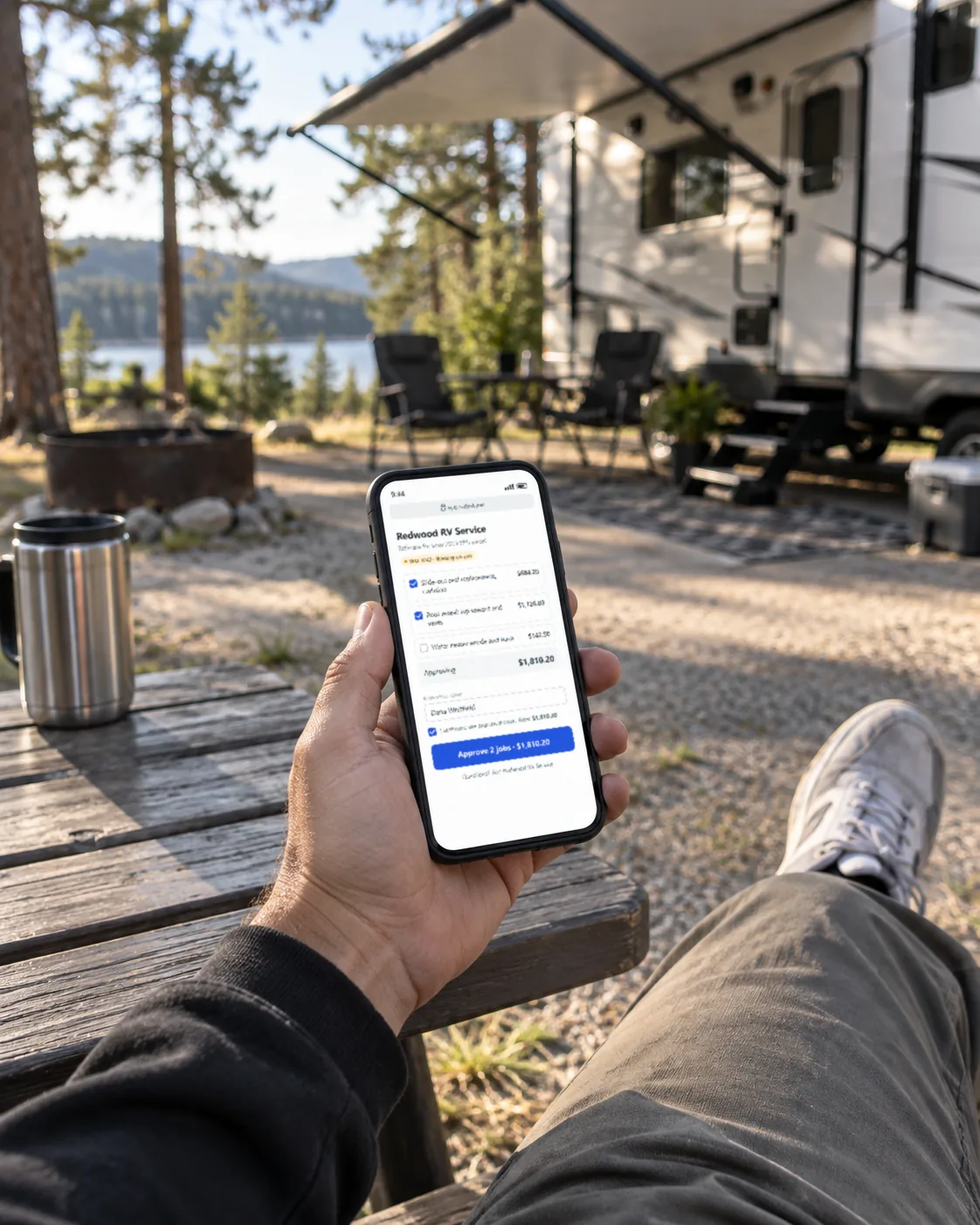
RV owners are often somewhere else when the work is finished. A spouse picks up the rig, the owner is at work, or the job was mobile service at a campground and you left before they got back. A payment link sent by text lets them open the invoice on their phone and pay, without reading a card number to your advisor over the phone.
The simplest version of this habit: send the pay link with the ready-for-pickup message. The customer reviews the invoice before they come in, pays when it suits them, and pickup takes five minutes instead of twenty.
In RVDesk, the invoice opens from a link with no account needed, and the customer can pay it online. If your shop texts from its own registered number, the link goes out as a text through two-way texting, and replies come back against the customer and the job.
Make payment at pickup the defaultLink to the section “Make payment at pickup the default”
For customers without approved terms, the keys come back when the invoice is paid. That is easier to hold to when it was said at drop-off and printed on the estimate. It also tends to be backed by law: many states give a shop that repairs a vehicle a lien that depends on keeping possession of it, though the rules differ by state.
- California’s Civil Code gives a person who repairs a vehicle of a type subject to registration a lien dependent upon possession for the compensation they are legally entitled to, with limits, notice rules and short deadlines for enforcing it.
- Texas law says a worker who repairs an article, including a vehicle, may retain possession until the amount due under the repair contract is paid.
The other side matters just as much. Florida’s Motor Vehicle Repair Act makes it unlawful for a covered shop to refuse to return a customer’s vehicle because the customer refused to pay for unauthorized repairs. Holding a rig only works when the bill matches what the customer authorized. Lien rules are technical and vary by state, so talk to an attorney before you rely on one for a disputed bill.
Document authorization so the bill holds upLink to the section “Document authorization so the bill holds up”
The fastest payment is an undisputed one. Customers pay promptly when the invoice matches what they approved, and when they don’t, the approval record is your evidence. In its guidance on card disputes for services, Stripe lists documentation showing the service was provided, such as a signed contract, a work order or another written agreement, along with things like the cardholder’s signature on a pickup form. Stripe also cautions that emails and texts on their own don’t verify who sent them, and that you get one chance to respond to a dispute, usually within 7 to 21 days depending on the card network.
Keep these with every job:
- The estimate the customer approved, job by job, with the approved total
- How and when they approved, and who approved it
- Any supplemental work and its separate approval
- Photos or inspection notes supporting the work
- The final invoice and a pickup signature where you can get one
Our guide on writing RV repair estimates customers approve covers how to record approvals and declines, including work you find mid-job.
Keep accounts receivable shortLink to the section “Keep accounts receivable short”
Money customers owe you after the rig has left is the most expensive kind to collect. A few habits keep that list short:
- Decide who gets terms. Commercial and fleet customers you have approved may pay on terms. Everyone else pays at pickup.
- Invoice the day the job is done. An invoice sent a week later tells the customer it can wait.
- Follow up on a schedule. Pick reminder points, such as the due date and a set number of days after, and use them for every account.
- Review open balances weekly. Sort by age. A balance that crosses 30 days gets a phone call, not another automatic reminder.
- Stop new work on overdue accounts. Until the balance is current, the next job is cash at pickup.
If you’re thinking about card surchargesLink to the section “If you’re thinking about card surcharges”
Some shops pass card processing costs to customers with a surcharge. If you consider it, the card networks have rules and some states restrict or prohibit the practice. Visa’s merchant guidance, for example, requires you to notify your acquirer at least 30 days before you start, allows surcharges on credit cards only (never on debit or prepaid cards), caps the surcharge at your processing cost for that card or 3%, whichever is lower, and requires clear disclosure at the point of entry, at the point of sale and on every receipt. Mastercard has its own rules, and both networks say state law still applies. Rules change, so confirm the current network rules and your state’s law with your payment processor before you add a surcharge.
Common questionsLink to the section “Common questions”
Should an RV repair shop take deposits?
For special-order parts and large jobs, a deposit at approval protects the shop if the customer cancels after parts are bought. State the amount, what it covers and the cancellation terms on the estimate, and record the deposit against the invoice.
Is a card payment on a reader safer than a keyed-in card number?
For fraud, yes. With a chip or contactless reader, the card issuer is generally liable for fraudulent-type disputes under the EMV liability shift. That protection does not cover other disputes, such as a claim that the work was not done as agreed.
What is text-to-pay?
A text message with a link to the customer’s invoice, which they open on their phone and pay online. It lets customers who are away from the shop pay without reading card numbers over the phone.
Can I keep a customer’s RV until the bill is paid?
Many states give repair shops a lien that depends on keeping possession of the vehicle, but the rules, limits and deadlines vary by state, and some states prohibit holding a vehicle over unauthorized charges. Check your state’s law before relying on it.
Want to see a deposit, a card reader payment and a text-to-pay link land on one invoice? Book a demo and we’ll walk through RVDesk payments with your shop in mind.
Sources
- Stripe Docs: How disputes work (docs.stripe.com)
- Stripe Docs: Dispute evidence best practices (docs.stripe.com)
- Stripe Docs: Dispute reason code categories (docs.stripe.com)
- Stripe Docs: Respond to disputes (docs.stripe.com)
- Stripe Support: How disputes work for Terminal (support.stripe.com)
- Stripe Docs: Terminal (in-person payments) (docs.stripe.com)
- Stripe Docs: Hosted invoice page (docs.stripe.com)
- Federal Reserve Bank of Atlanta: 2025 Survey and Diary of Consumer Payment Choice, Summary Results (May 2026) (atlantafed.org)
- Visa: U.S. Merchant Surcharge Q&A (usa.visa.com)
- Mastercard: Credit card surcharge rules and fees for merchants (mastercard.com)
- California Civil Code § 3068 (lien for vehicle repair) (leginfo.legislature.ca.gov)
- Texas Property Code § 70.001 (worker’s lien and possession) (statutes.capitol.texas.gov)
- Florida Statutes § 559.909 (refusal to return vehicle prohibited) (leg.state.fl.us)
We build RVDesk alongside a mobile RV repair business in Redding, California.