
How to Start a Mobile RV Repair Business
What it takes to start a mobile RV repair business: RVTI certification, tools and van setup, insurance and licensing to check, scheduling, and getting paid.
On this page
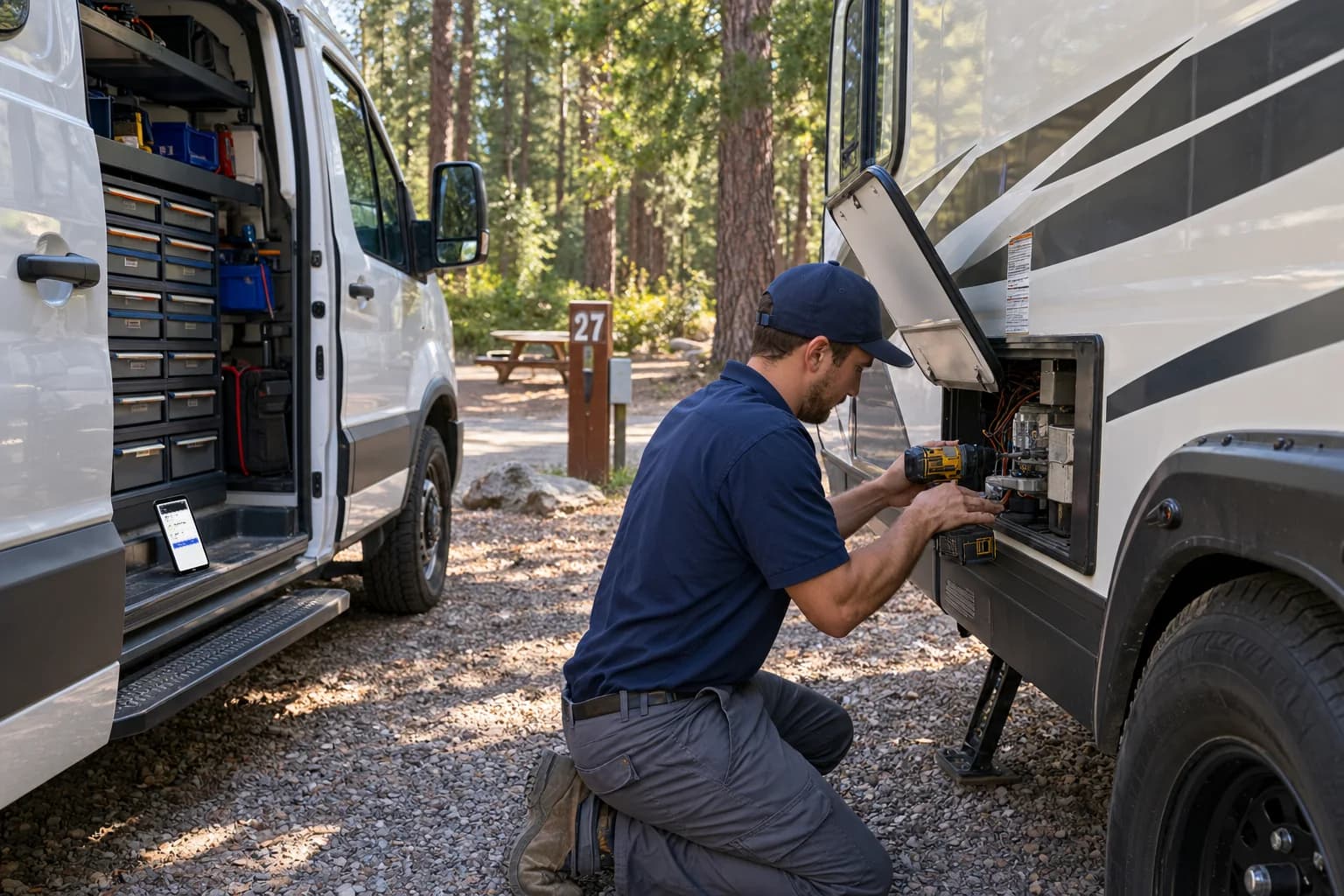
A mobile RV repair business goes to the rig instead of waiting for the rig to come in: driveways, storage lots, campgrounds and job sites. There is no building to lease, but the truck becomes the shop, the phone becomes the front counter, and every hour behind the wheel is an hour nobody pays for unless you plan for it.
This guide covers what a technician needs to think through before going out on their own: skills and certification, tools and van setup, the insurance and licensing questions to settle locally, scheduling, quoting and getting paid at the customer’s site, and keeping records from a phone. It is practical guidance, not legal or insurance advice; the rules that apply to you depend on your state, county and city.
Skills and certificationLink to the section “Skills and certification”
RVs combine systems that are usually separate trades: 12-volt DC and 120-volt AC electrical, LP-gas appliances, plumbing, roofs, slide-outs, leveling systems and, on motorhomes, a chassis. The RV Industry Association adopts the standards RVs are built to, including NFPA 1192 (fuel systems, fire and life safety, plumbing and vehicular requirements), the National Electrical Code and an ANSI/RVIA standard for low-voltage DC systems. A mobile tech works on all of it, usually alone.
The RV Technical Institute, whose curriculum was funded by the RV Industry Association and the RV Dealers Association, offers a four-level path:
| Level | What it covers | How it’s kept current |
|---|---|---|
| Level 1 | Pre-delivery inspection: verifying that an RV’s components work. Written and practical exams. | Good for life, with a yearly information and employment check-in. |
| Level 2 | Knowledge of all RV systems and the ability to do basic diagnostics, troubleshooting and repairs. Level 1 and Level 2 written and practical exams. | Five years, with 24 hours of continuing education. |
| Level 3 | Specialties earned through approved vendor training: electrical, chassis, electronics, appliance and slide-out. | Five years, with 24 hours of continuing education, at least 8 of them in the specialty held. |
| Level 4 | Master Technician: all five specialties completed, with 120 total training hours within five years. | Five years, with 24 hours of continuing education. |
RVTI’s published course listings have shown Level 1 as a one-week, in-person course at its campus in Elkhart, Indiana, and Level 2 as a hybrid of online coursework followed by an in-person week. It has also offered a yearly option aimed at mobile technicians and individuals. Schedules, formats and prices change, so check RVTI’s site for current details before you plan around them.
Certification is an industry credential. It shows customers and insurers that you’ve been tested, but it is not the same thing as a state or local license, which is a separate question covered below.
Tools and van setupLink to the section “Tools and van setup”
Build the van around the work you plan to sell, not around a catalog. A practical starting kit, grouped by system:
- Electrical: a digital multimeter, a clamp meter, a 12-volt test light, a receptacle tester for checking campground power, crimpers and an assortment of terminals, fuses and breakers.
- LP-gas: a manometer for pressure checks and leak-detection solution. Appliance manuals give the pressure to test against; Dometic’s Atwood water heater manual, for example, calls for 11 inches of water column with three appliances running.
- Water systems: an air compressor with a regulator, a blowout plug, a hand pump and RV antifreeze for winterizing season.
- Roofs and exterior: a ladder that meets OSHA’s portable ladder guidance, roof cleaner, and sealants matched to the roof types you service.
- Batteries: a battery tester and a charger.
- General: hand and cordless tools, lighting, a creeper, wheel chocks, and the fast-moving parts you see most often in your area.
Fit the van so everything has a fixed place and stays put on rough campground roads. If you carry propane cylinders, follow the National Propane Gas Association’s guidance as published by New Jersey’s Division of Codes and Standards: keep cylinders upright, keep the vehicle ventilated with the valve closed and plugged or capped, and don’t leave a cylinder sitting in a vehicle.
Insurance and licensing: categories to check locallyLink to the section “Insurance and licensing: categories to check locally”
Nothing here is legal or insurance advice. These are the categories to ask about where you work, and the people who can answer them are your state and local agencies, a licensed insurance agent and, where needed, an attorney or accountant.
Licenses and registrationsLink to the section “Licenses and registrations”
- General business licensing. The U.S. Small Business Administration notes that licensing and permit requirements depend on your business activities and location, vary by state, county and city, and suggests starting with your Secretary of State’s website.
- Sales tax. If you sell parts, ask your state tax agency whether you need a seller’s permit or sales tax registration.
- Vehicle repair registration. Some states regulate repair businesses. California’s Bureau of Automotive Repair, for example, has rules for mobile automotive repair dealers that took effect October 1, 2025, including providing a physical address where records are kept and recording on the final invoice where the repairs were performed. Ask your state agency how its rules apply to RV work, including coach work on a motorhome and work on towables.
- LP-gas work. Some states regulate LP-gas activities. In Texas, the Railroad Commission’s employee-level RV technician exam qualifies a person to install and repair LP-gas systems on RVs; it does not authorize filling containers.
InsuranceLink to the section “Insurance”
The SBA lists general liability, commercial property, professional liability and business owner’s policies among the common types, and notes that businesses with employees are required to carry certain coverage, such as workers’ compensation, with requirements that vary by state. For a mobile RV business, take these questions to your agent:
- Does my auto policy cover a vehicle used for business, or do I need a commercial auto policy?
- Am I covered for damage to a customer’s RV while I’m working on it?
- Are my tools and parts covered while they’re in the van, including overnight?
- What changes when I hire my first employee?
Scheduling and routingLink to the section “Scheduling and routing”
In a mobile business, the schedule is the profit. A job that pays well but sits an hour away in the wrong direction can cost you the two jobs you could have done instead. A few habits help:
- Group jobs by area and by day, and build realistic drive time between them into the schedule.
- Confirm the details before you roll: the exact location, campground site number, gate or storage lot access hours, and whether shore power and water are available.
- Ask for photos of the problem and of the RV’s labels and data plates so you bring the right parts the first time.
- For parts-dependent repairs, plan on a diagnosis visit and a return visit, and tell the customer that up front.
- Leave margin in the day for jobs that turn out bigger than described.
Scheduling in RVDesk ties each appointment to a work order, so the booking and the job are the same record. You can assign the technician when booking, see the day and the week, and keep the promise time on the job.
Quoting and getting paid on siteLink to the section “Quoting and getting paid on site”
The worst time to discuss money is after the work is done and you’re packing up. Settle it before you pick up a tool:
- Diagnose, then quote each repair as its own line, with parts and labor from your own rates.
- Get approval in writing before you start. If the owner isn’t on site, as often happens at storage lots, send the estimate as a link they can approve from their phone.
- If you find more work partway through, stop and get the additional lines approved before you do them.
- Take payment before you leave, or send a payment link while you’re still on site.
With RVDesk estimates, canned jobs keep your common repairs quoted the same way every time, the customer approves line by line from a link with no account, and each approval is recorded with a timestamp against the work order. The approved estimate becomes the invoice, so nothing is typed twice on a tailgate.
For payment, RVDesk card payments run through your own Stripe account and settle to your bank. You can send the customer a link to pay the invoice online, and card, cash and check payments all land on the same ledger against the invoice. A deposit now and a balance later are two entries on one invoice. Once your shop’s texting number clears carrier registration, the payment link and job updates can go out by text from your own number.
Keep records from your phoneLink to the section “Keep records from your phone”
A mobile tech has no filing cabinet, and a regulator, a warranty administrator or an unhappy customer can all ask what you did and where. Keep the record as you work, on the phone you already carry:
- The customer and the rig: year, make, model, VIN and plate, plus notes that will matter next time.
- Inspection findings with photos, taken before and after the repair.
- The approved estimate, any additional approvals, and the invoice and payment.
- Where the work was done. In California, the mobile repair rules above make that an invoice requirement.
- The time you spent on each job, so you know which work actually pays.
RVDesk is built for a mobile tech to run from a phone. Customer records hold each rig’s details and service history, technicians fill in inspections with photos on a phone, photos and notes stay with the work order, and the time clock records hours against the job as well as the day.
If you’re adding services, two of our maintenance guides make good standard jobs for a mobile truck: the RV roof inspection and resealing guide and the RV winterization service checklist.
A launch checklistLink to the section “A launch checklist”
- Training plan set, with RVTI levels or vendor training you’ll pursue
- Business licensing confirmed with your state, county and city
- Sales tax registration confirmed for the parts you’ll sell
- Vehicle repair and LP-gas licensing questions answered by your state agencies
- Insurance in place after a conversation with a licensed agent
- Van fitted, with tools and common parts in fixed places
- Service area and a typical day’s route mapped out
- Standard jobs written up with consistent descriptions and pricing
- Payment terms written into your estimates
- A system for customers, rigs, estimates, invoices, payments and photos that works from your phone
Common questionsLink to the section “Common questions”
Do you need certification to be a mobile RV technician?
RV Technical Institute certification is an industry credential, not a government license. Whether a license is required depends on where you work and what you do: some states regulate vehicle repair businesses or LP-gas work, such as the Texas Railroad Commission’s LP-gas exam for installing and repairing RV propane systems. Check with your state and local agencies.
What are the RV Technical Institute certification levels?
There are four. Level 1 covers pre-delivery inspection. Level 2 covers diagnostics, troubleshooting and repair across all RV systems. Level 3 adds specialties through approved vendor training in electrical, chassis, electronics, appliance and slide-out. Level 4 Master Technician requires all five specialties.
What insurance does a mobile RV repair business need?
It depends on your state, your vehicle and whether you have employees. The SBA lists general liability, commercial property, professional liability and business owner’s policies as common types, and businesses with employees must carry certain coverage such as workers’ compensation. Ask a licensed agent about business use of your vehicle, damage to a customer’s RV and tools in the van.
How do mobile RV techs get paid on site?
Agree on the price and payment terms before the work starts, then take payment by card, cash or check before leaving, or send a payment link while still on site. Record every payment against the invoice so the balance is always right.
Want to see how a mobile tech can run estimates, approvals and payments from a phone? Book a demo and we’ll walk through it with your service area in mind.
Sources
- RV Industry Association: RV Technical Institute technician path and curriculum (rvia.org)
- RV Industry Association: RV Technical Institute frequently asked questions (rvia.org)
- RV Industry Association: Upcoming RV Technical Institute courses, December 2024 (rvia.org)
- RV Industry Association: Association and ANSI adopted standards (rvia.org)
- U.S. Small Business Administration: Apply for licenses and permits (sba.gov)
- U.S. Small Business Administration: Get business insurance (sba.gov)
- California Bureau of Automotive Repair: Mobile repair, referral services, and online advertising regulations (October 2025) (bar.ca.gov)
- Railroad Commission of Texas: LP-Gas Examination Study Guide, Recreational Vehicle Technician (employee level) (rrc.texas.gov)
- Dometic (Atwood): Water Heater Models 4, 6, 10 Operation Manual (gas pressure), hosted by Forest River (forestriverinc.com)
- New Jersey Division of Codes and Standards: Propane gas grill and range safety tips (provided by the National Propane Gas Association) (nj.gov)
- OSHA: Portable Ladder Safety QuickCard (osha.gov)
We build RVDesk alongside a mobile RV repair business in Redding, California.